Five of the world’s top ten fastest-growing economies in 2027 are in the Middle East. That’s not a coincidence, it’s a rebound story.
According to the IMF’s October 2026 World Economic Outlook, Iraq leads the global rankings with projected real GDP growth of 19.0%, followed by Qatar at 18.8% and Kuwait at 17.1%. These numbers look extraordinary on paper, and they are, but context matters. Each of these economies contracted sharply in 2026 as the Iran war disrupted energy production and choked off shipping through the Strait of Hormuz. The IMF projects that shipping will gradually resume from March 2027, returning broadly to prewar conditions by October. What looks like a growth miracle is, in large part, oil exports coming back online.
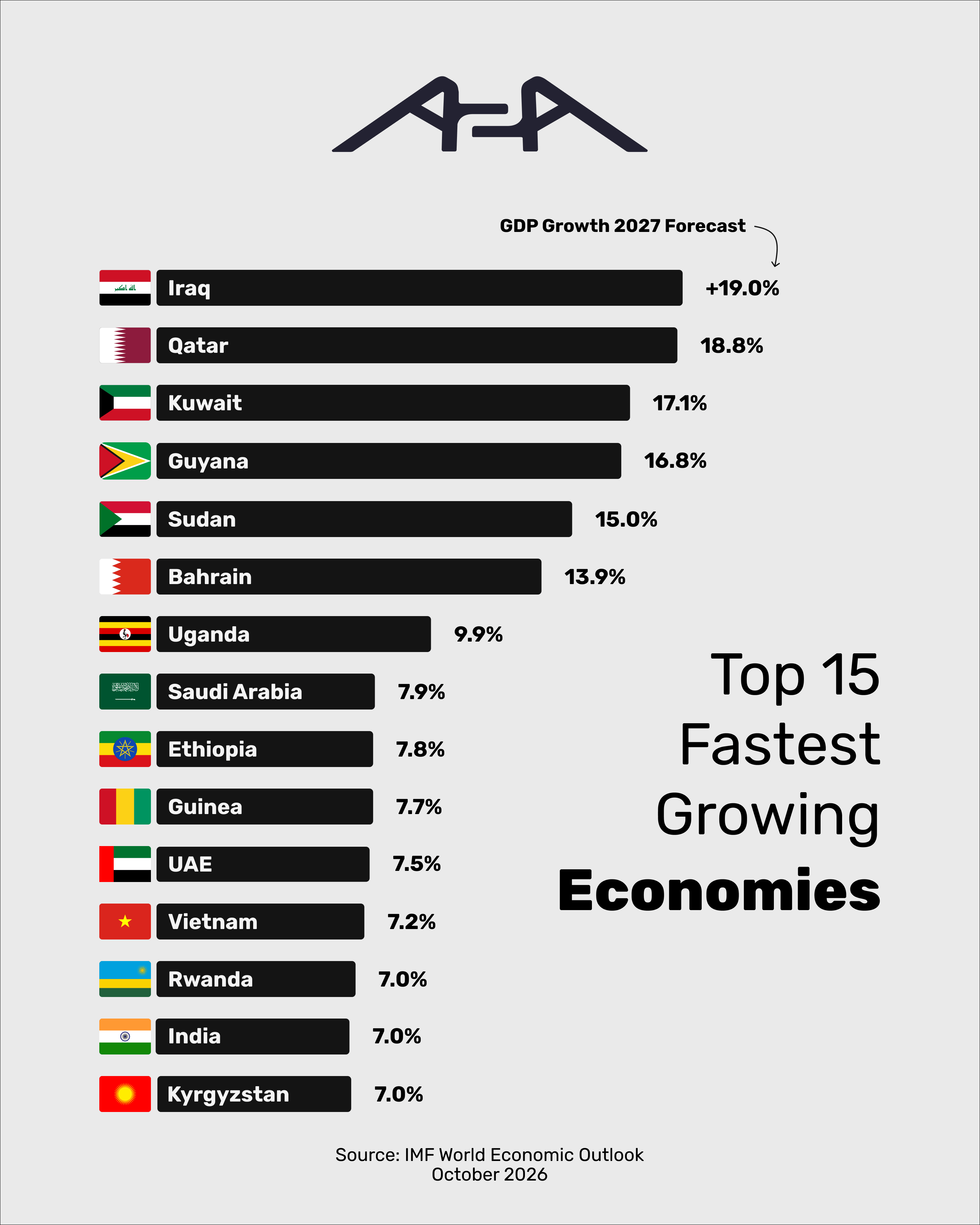
Source: IMF World Economic Outlook, October 2026
What’s driving the numbers
The Middle East accounts for five of the top six spots. Beyond the Iran war rebound, these economies share a common driver: energy. When oil and gas flow, GDP follows. The region’s growth is not broad-based diversification, it’s the resumption of what was always there.
The standout outside the Middle East is Guyana at 16.8%, ranked fourth globally. Guyana has been on this list for several years running as offshore oil production continues to scale. This is not a rebound, it’s a structural build. The country had almost no oil industry a decade ago; now it has one of the fastest-growing economies on the planet.
Further down the list, the story changes. Vietnam at 7.5% is growing through manufacturing exports, benefiting from supply chains that have been redirecting away from China for the better part of a decade. India at 7.0% is driven by domestic consumption and a services sector that keeps compounding. Both are structural, not cyclical.
The UAE sits at 7.7%, ranking 11th globally. For a mature, diversified economy, one that has deliberately built non-oil sectors in real estate, logistics, finance, and tourism, that number is significant. It reflects not a rebound but a continued trajectory.
What it means for real estate
Growth at this scale in the Middle East and in emerging markets like India and Vietnam has a direct and consistent effect on real estate: capital moves. High-growth economies generate wealth faster, and that wealth seeks assets, often property, often cross-border.
For agents working in Dubai, the UAE’s 7.7% growth forecast is relevant not just domestically, but as a signal about where buyers are coming from. Iraq, Qatar, Kuwait, and Bahrain at the top of this list are markets with significant concentrations of high-net-worth individuals who historically park capital in UAE real estate. When those economies rebound, deal flow follows.
That’s the opportunity. And it’s exactly the kind of cross-border dynamic that A2A is built to serve.