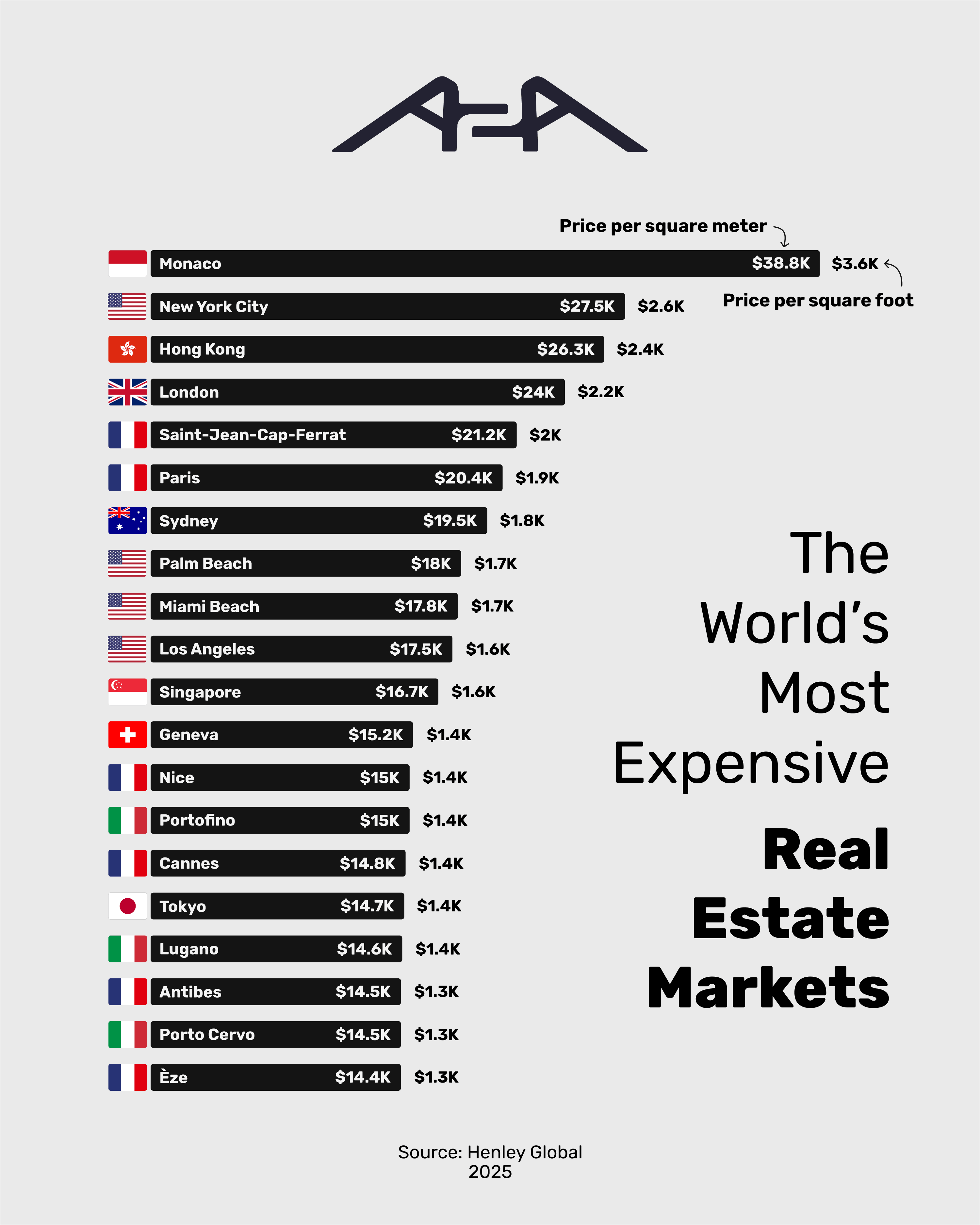
Monaco sits at the top. It has for years. At roughly $50,000 per square metre for prime residential property, it is in a category of its own, a city-state with no room to build, no income tax, and a concentration of wealth that keeps demand permanently ahead of supply.
New York City and Hong Kong follow. Both carry price tags that reflect something beyond real estate: they are entry points into two of the most powerful economic ecosystems on the planet.
What Makes a Market “Prime”
Prime real estate is not simply expensive property. It is a specific category defined by four overlapping factors.
High value per square metre. Prime markets sit at the top of global price rankings, typically in major cities or exclusive resort destinations where land is scarce and demand is structural.
Luxury specification. These properties offer superior finishes, amenities and design. The product itself commands a premium, not just the location.
Strategic positioning. The most sought-after prime markets combine lifestyle appeal with economic stability and access to global networks. Buyers are not purchasing a home in isolation. They are purchasing proximity to capital, culture and opportunity.
Investment-linked benefits. Many prime markets are tied to residence or citizenship by investment programmes, adding a layer of utility that goes beyond property ownership and attracts a globally mobile buyer pool.
Six French Cities in the Top 20
One of the more striking findings in the latest global rankings is the concentration of French cities. Six make the top 20, reflecting the enduring appeal of the French Riviera, Paris and a handful of resort markets that have maintained their status across generations of wealthy buyers.
France’s combination of lifestyle, infrastructure, legal stability and cultural capital continues to position it as one of the most resilient prime markets in the world.
Source: Henley Global
Where Borders Stop Mattering
The agents operating in or adjacent to these markets are not selling square metres. They are selling access, status and optionality.
Understanding the buyer in a prime market means understanding that the decision is rarely purely financial. It is about where they want to be, what that location says about them, and what it enables. Data matters. So does discretion. So does knowing which buyers are serious and which are touring.
The agents who close in these markets are the ones who have built the right relationships across borders, not just within them.
That is what A2A is built for.
Read the full article at a2a.news, join the network at a2a.pro