Europe is stagnating. The world’s most developed economies are barely moving. These are the 20 Slowest Growing Economies 2027.
According to the IMF’s October 2026 World Economic Outlook, three economies are projected to contract in 2027: Bolivia at −1.5%, Equatorial Guinea at −1.0%, and Haiti at −0.5%. Yemen holds flat at 0.0%. Below them sits a roster that reads like a map of Western Europe — Italy at 0.6%, France at 0.7%, Austria at 0.9%, Germany at 1.1%, the UK at 1.2%.
The 20 Slowest Growing Economies in 2027
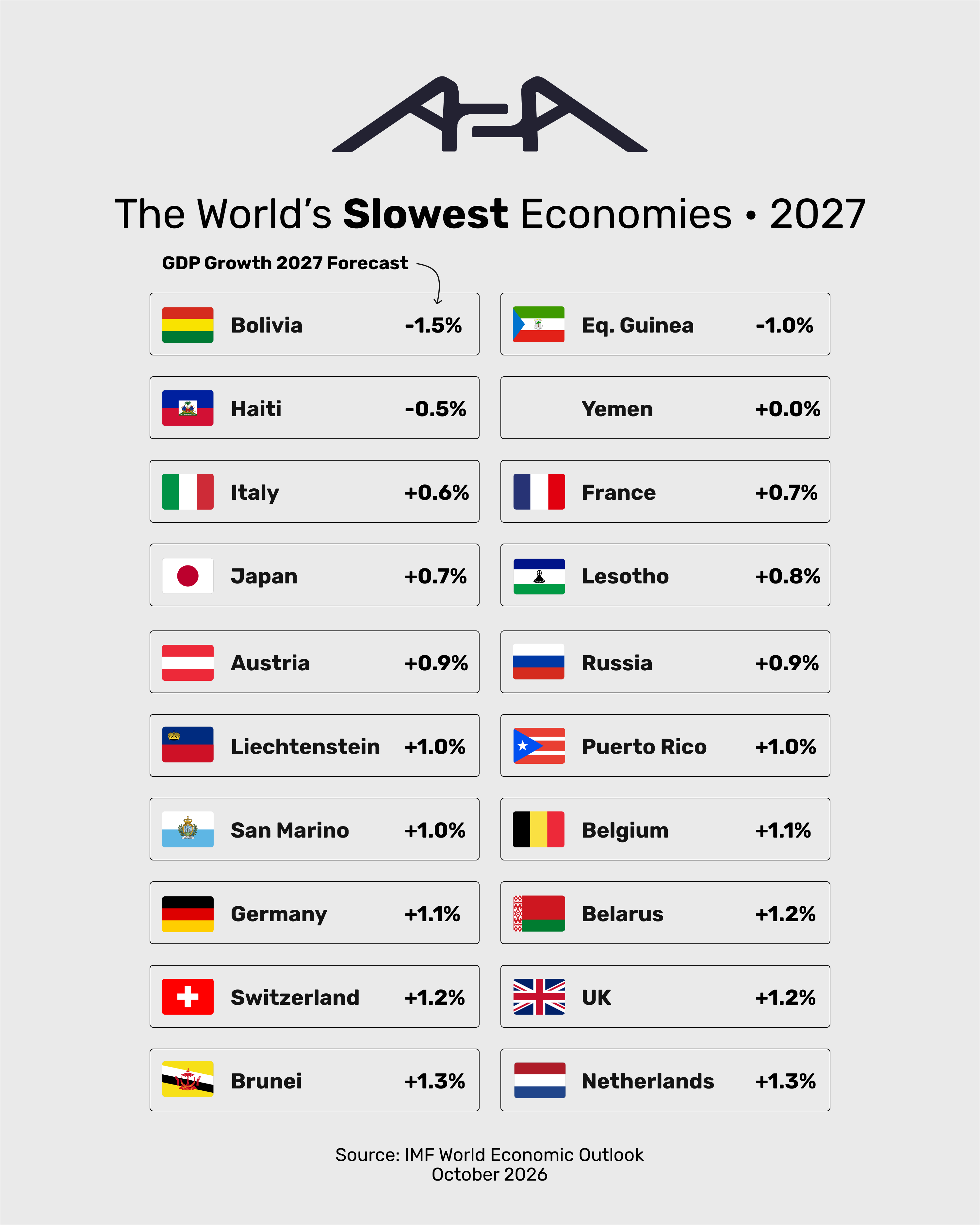
Source: IMF World Economic Outlook, October 2026
What’s driving the numbers
The contraction stories are distinct. Bolivia is in a prolonged fiscal crisis, a decade of declining natural gas revenues, unsustainable subsidies, and a foreign currency shortage that has made imports difficult and investment scarce. Equatorial Guinea is an oil-dependent economy whose reserves are running out, with no meaningful diversification to show for the years of windfall. Haiti needs no explanation.
The European picture is different in nature but consistent in pattern. These are wealthy, mature economies dealing with the same set of compounding pressures: aging demographics that reduce labour force participation, energy costs that remain structurally elevated since 2022, and sluggish productivity growth that decades of low interest rates failed to fix. Germany, the continent’s largest economy sits at 1.1%, still struggling with the industrial model that made it dominant in a world of cheap Russian gas and open Chinese markets. France at 0.7% is weighed down by pension reform stalemate, weak business investment, and a political environment that has made structural reform consistently difficult.
Japan at 0.7% is a separate category: a high-income economy with decades of experience managing near-zero growth, aging demographics, and deflation risk. It is not in crisis, it has normalised stagnation.
Russia at 0.9% is forecast-dependent. The IMF’s figure reflects a wartime economy that has adapted but not thrived, redirected trade flows, energy revenues under pressure from price caps, and a sanctions environment that limits technology imports. It is a number to treat with more uncertainty than most.
What it means for real estate
Slow-growth economies do not generate new wealth at scale, but they do relocate existing wealth. When domestic returns stagnate, capital moves. European high-net-worth individuals with mature portfolios increasingly allocate to higher-growth markets: the UAE, Southeast Asia, parts of Latin America.
That outflow is already visible in Dubai transaction data. French, German, British, and Italian buyers consistently appear in the top ten nationalities transacting in Dubai real estate. The relationship is not incidental, it reflects exactly the dynamic the IMF data describes. When your home economy is growing at 0.7%, a market offering 7.7% GDP growth, zero capital gains tax, and full foreign ownership looks very different.
For agents working cross-border, the slowest economies list is not a problem, it’s a source list. The buyers are there. They’re looking for somewhere better to put their money.
That’s the market A2A is built to connect.